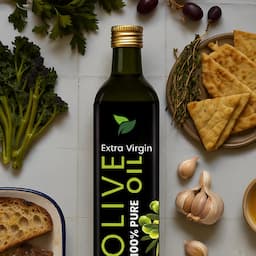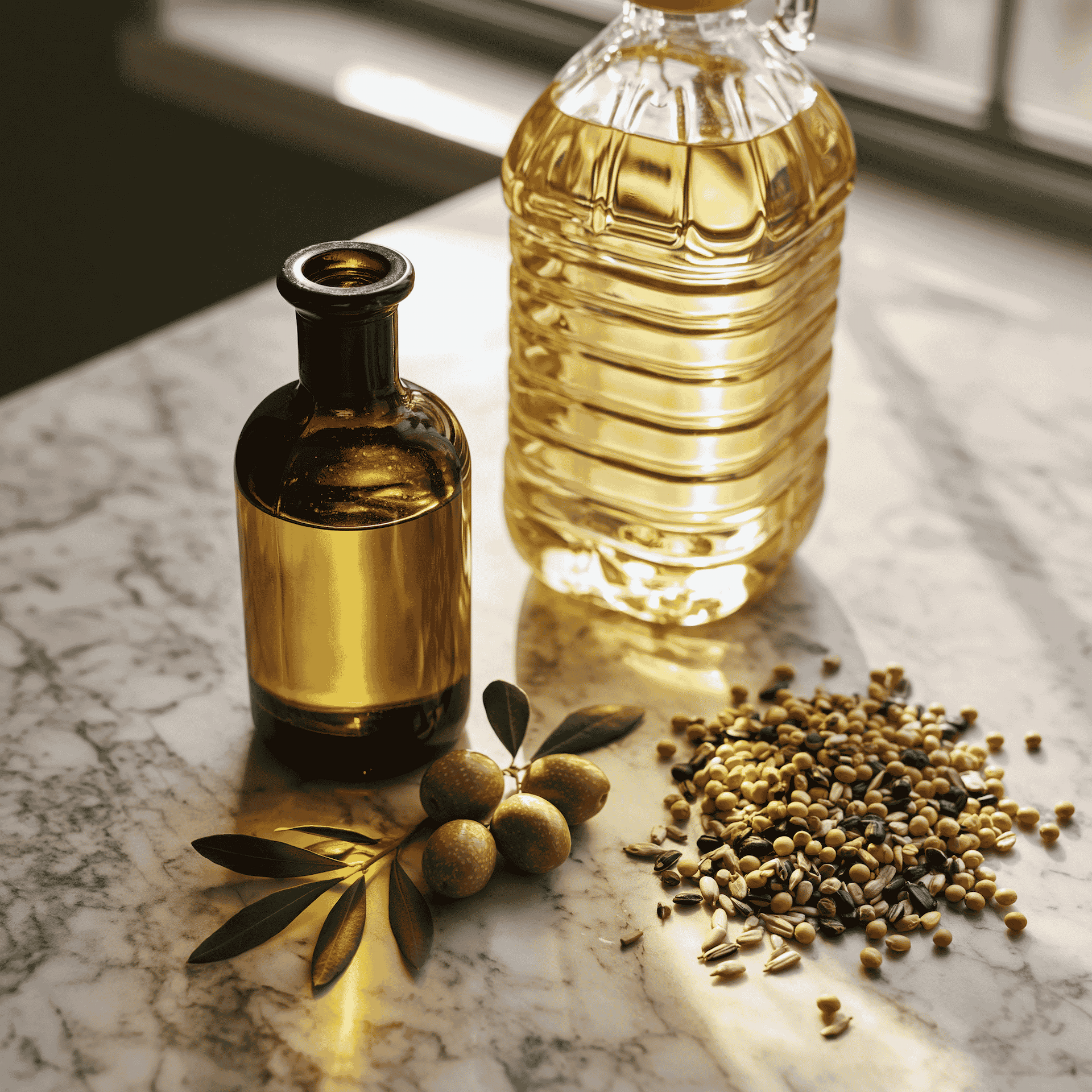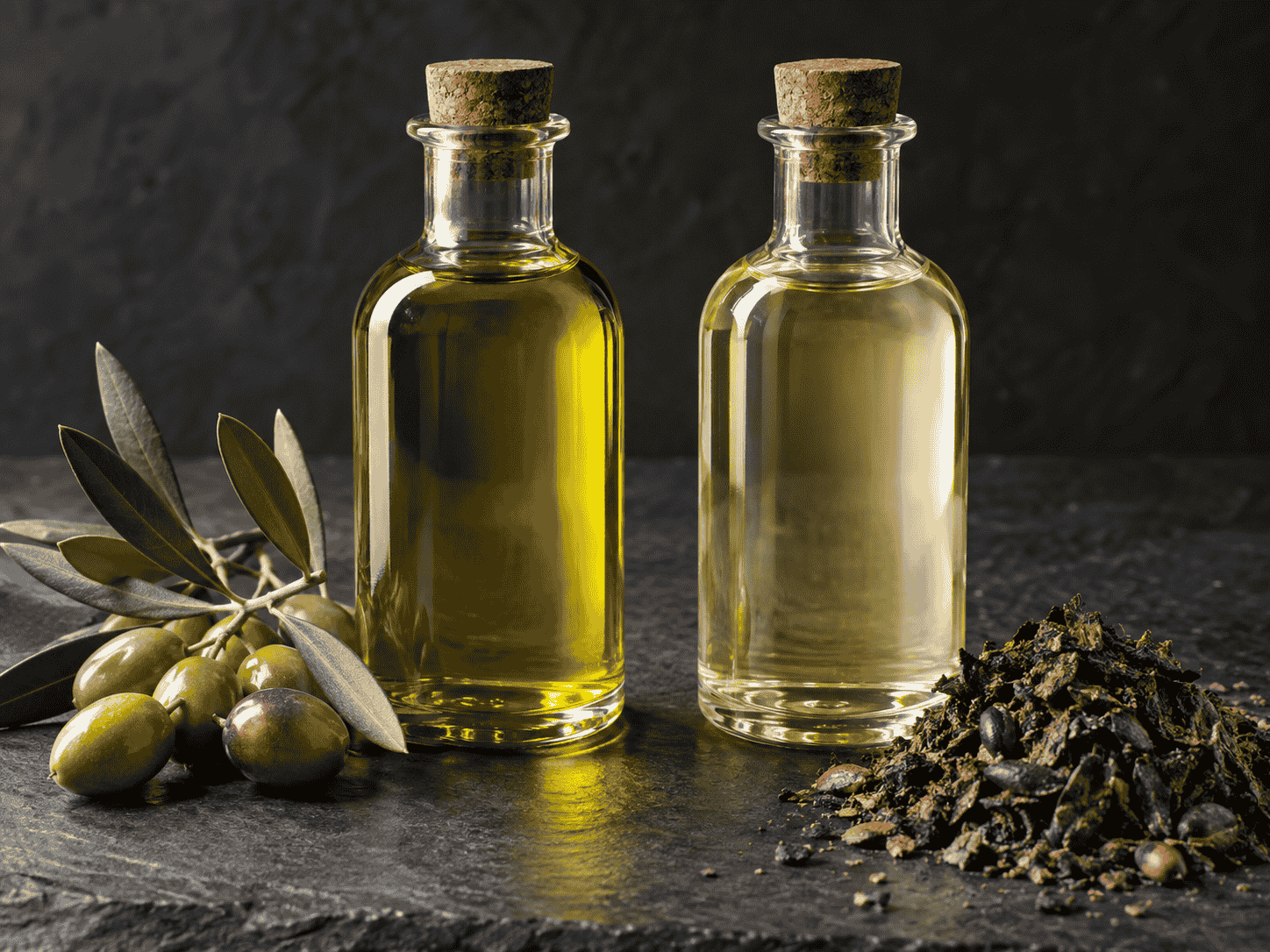
Extra virgin olive oil (EVOO) is the juice extracted from olives by mechanical means only, with a maximum free acidity of 0.8%, and it is never chemically refined. Olive-pomace oil is refined pomace oil blended back with virgin olive oil, in its own legal category. Both are genuine olive oils — only one is unrefined. For most Pakistani homes, the smart answer is to keep both: EVOO for flavour and finishing, pomace for economical frying.
Pakistani buyers keep asking which one is "asli". The honest answer: both are, legally and chemically. The real choice is about flavour, processing, budget, and intended use — not real versus fake.
EVOO can be cooked with too. So this is not a story of a good oil and a bad oil — it is two grades built for two different jobs.
EVOO vs Pomace: The Core Difference
The clearest way to see the difference is side by side, across the factors that actually decide your choice in a Pakistani kitchen.
| Feature | Extra Virgin Olive Oil | Olive-Pomace Oil |
|---|---|---|
| Production | Mechanical extraction | Pomace recovery + refining + virgin blend |
| Refined? | No | Yes |
| Flavour | Fruity, bitter/peppery | Neutral |
| Polyphenols | Higher | Lower |
| High-volume frying | Suitable but expensive | Practical / economical |
| Salads & finishing | Excellent | Less suitable |
| Price | Higher | Lower |
Read it as a division of labour, not a winner and a loser. EVOO wins on flavour and phenolics; pomace wins on heat tolerance and price.

What Is Extra Virgin Olive Oil?
EVOO is the top grade in the olive oil family. It is cold-extracted, must carry no sensory defects, must stay under 0.8% free acidity, and retains the vitamins, minerals, and antioxidants naturally present in the fruit.
Its character depends on the variety. Picual tends to be bitter and pungent; Arbequina is gentle and sweet. Early-picked fruit yields less oil but more healthy compounds.
One detail trips up almost every buyer: a lower acidity number does not automatically mean higher quality. Refining itself drives acidity down.
So a refined oil can print 0.2% and still be nutritionally hollow, while a superb monovarietal EVOO shows 0.4%. Acidity is one classification parameter, not a 0-to-10 quality score.
What Is Pomace Olive Oil?
Pomace olive oil kya hai, in one line: it is the oil recovered from what the press could not squeeze out — refined to food grade, blended with virgin olive oil, and legally sold under its own name.
It is a regulated food product suited to culinary use, not scraped waste. EU rules list it among the eight legal olive oil categories, alongside intermediate stages you never see on a shelf.
Under Codex and IOC standards, the final retail oil must sit at or below 1.0% free acidity, and its refined parent below 0.3%. These are chemistry thresholds, not marketing tiers.
Confusion starts in Pakistan because shopkeepers say "zaitoon ka tail" for everything. A blend labelled only "olive oil" is refined olive oil mixed with virgin — not shorthand for the top grade.
Practically, pomace gives a neutral profile with no pungency and almost no bitterness, which is why it disappears into biryani. For the fuller picture, see olive pomace oil health benefits.
How They're Produced
Think of it as two roads leaving the same mill. On the virgin-oil route, olives are picked, washed, crushed, and spun. What comes off is already edible — no chemical refining, nothing neutralised.
Sensory assessment and chemical criteria then decide whether that oil is extra virgin, virgin, or lampante. A trained panel scores defects; the lab checks acidity, peroxides, and related parameters.
On the pomace route, what is left behind — a wet paste of crushed stone, pulp, skin, and water — still holds residual oil. That residue is where olive-pomace oil begins.
Traditional recovery of that oil can involve solvent extraction using hexane, followed by refining — the same broad logic used for canola and sunflower oils. Gentler thermal and mechanical methods also exist.
The extract is refined until edible, then blended with virgin oil to restore some flavour, colour, and aroma. If a domestic brand cannot tell you which method its supplier used, that is a fair question to ask.
EVOO vs Pomace for Cooking and Frying
"Kya extra virgin olive oil khana pakane ke liye hai?" Yes — it is perfectly usable for hot cooking, and no rule reserves it for raw dishes. Spanish and Italian home kitchens fry in it daily.
Smoke point is where most articles overreach. Refined pomace is cited around 240°C, EVOO around 190–207°C — but these vary with grade, free fatty acids, and the condition of the oil.
More importantly, smoke point is not the same as oxidative stability. EVOO resists oxidation well thanks to its oleic acid and natural antioxidants, performing better under heat than many seed oils despite a lower smoke point.
Spain's Instituto de la Grasa (CSIC) compared pomace oil against sunflower and high-oleic sunflower oil in repeated potato frying. Pomace showed the lowest rates of polar-compound formation — the standard measure of frying degradation.
For context, 25% polar compounds is Spain's legal rejection threshold. Sunflower oil reached it fastest; pomace degraded slowest, thanks to minor components like squalene, sterols, and triterpenic compounds.
For karahi, the neutral flavour is a feature — you want tomato, ginger, and cumin, not a competing olive note. That is the whole argument in halwai shops and restaurant kitchens: stability plus price.
So map it to your kitchen: use pomace for deep-frying pakoras, fish, and high-heat karahi; use extra virgin for salads, dips, raita, and finishing, where you actually taste the oil. See olive oil for cooking for more.
Keep a 1L bottle of pomace olive oil for daily desi cooking — karahi, tarka, biryani, and deep-frying, where volume and heat matter more than flavour. Keep a smaller 500ml extra virgin for raw use, dressings, raita, and finishing, where you actually taste the oil and its phenolic compounds stay intact. Match package size to how fast you'll use it — a 5L EVOO tin oxidises long before you finish it.
Nutrition and Health Differences
"Pomace olive oil sehat ke liye theek hai ya nahi?" It is a regulated, nutritionally reasonable cooking fat, dominated by monounsaturated fatty acids — mostly oleic acid, an omega-9.
Where it falls short of EVOO is antioxidants. Refining strips most of the phenolic compounds behind extra virgin's reputation — the single clearest nutritional difference between the two.
EVOO has the stronger evidence base for health benefits because it retains those phenolics — hydroxytyrosol and oleocanthal among them — studied in relation to heart disease, stroke, and chronic inflammation.
Pomace has been studied directly. Randomised crossover trials by Spain's ICTAN-CSIC in healthy and hypercholesterolemic adults found modest effects.
In one trial, pomace oil reduced LDL cholesterol and apolipoprotein B versus high-oleic sunflower oil. In another, lipid markers were largely unchanged but visceral fat decreased. These are short interventions, not long-term outcome studies.
The fair conclusion: health benefits track dietary patterns where olive oil replaces less favourable fats — not treating any olive oil as a medicine.
Is Pomace Olive Oil Safe?
This deserves a straight answer rather than scare marketing. Historically, inappropriate drying or processing raised concerns about PAH contamination, including benzo(a)pyrene.
In 2001, elevated levels in some Spanish pomace batches led to withdrawals and tighter regulation. Modern limits and controlled processing are designed to minimise this risk.
In the EU, the maximum for benzo(a)pyrene in oils and fats is 2 µg/kg, with 10 µg/kg for the sum of four indicator PAHs, under Regulation (EU) 2023/915.
So the practical rule is sourcing, not panic. Ask for the origin country, ask whether refining was temperature-controlled, and avoid loose oil sold from unmarked drums — unfortunately common in local markets.
If you are buying for children or massage, a well-documented unrefined oil removes the ambiguity. See asli zaitoon ka tail for how to spot adulterated stock.
Price and Value: Which to Buy in Pakistan
EVOO usually carries a substantial price premium over pomace per litre in Pakistan. That gap reflects yield, extraction method, and grade — not packaging.
That also answers "dono mein price ka farq kyun hai": you are paying for nutrients preserved by cold pressing, not a fancier bottle.
So the value question is about allocation, not which oil is "worth it". Spend the premium on a small EVOO bottle you use raw and you get the compounds you paid for; spend it on a 5L frying tin and you don't.
Match package size to your actual consumption — 500ml of EVOO gets used while fresh, while a 5L tin opened in a Karachi June oxidises before you finish it. Check the current olive oil price in Pakistan before deciding your split.
And if a "premium extra virgin" is priced at pomace level, be sceptical — genuine early-harvest EVOO is not cheap to produce.
Olive Oil Grades and How to Read the Label
Zaitoon ka tail ki iqsam are defined by free acidity, a sensory panel, and a lab report — not by a marketing ladder.
At the top sits EVOO (under 0.8% acidity, zero defects). Below it, virgin olive oil allows up to 2% and minor flaws. Then plain "olive oil", a refined-virgin blend. Lampante never reaches a shelf; finally the pomace family.
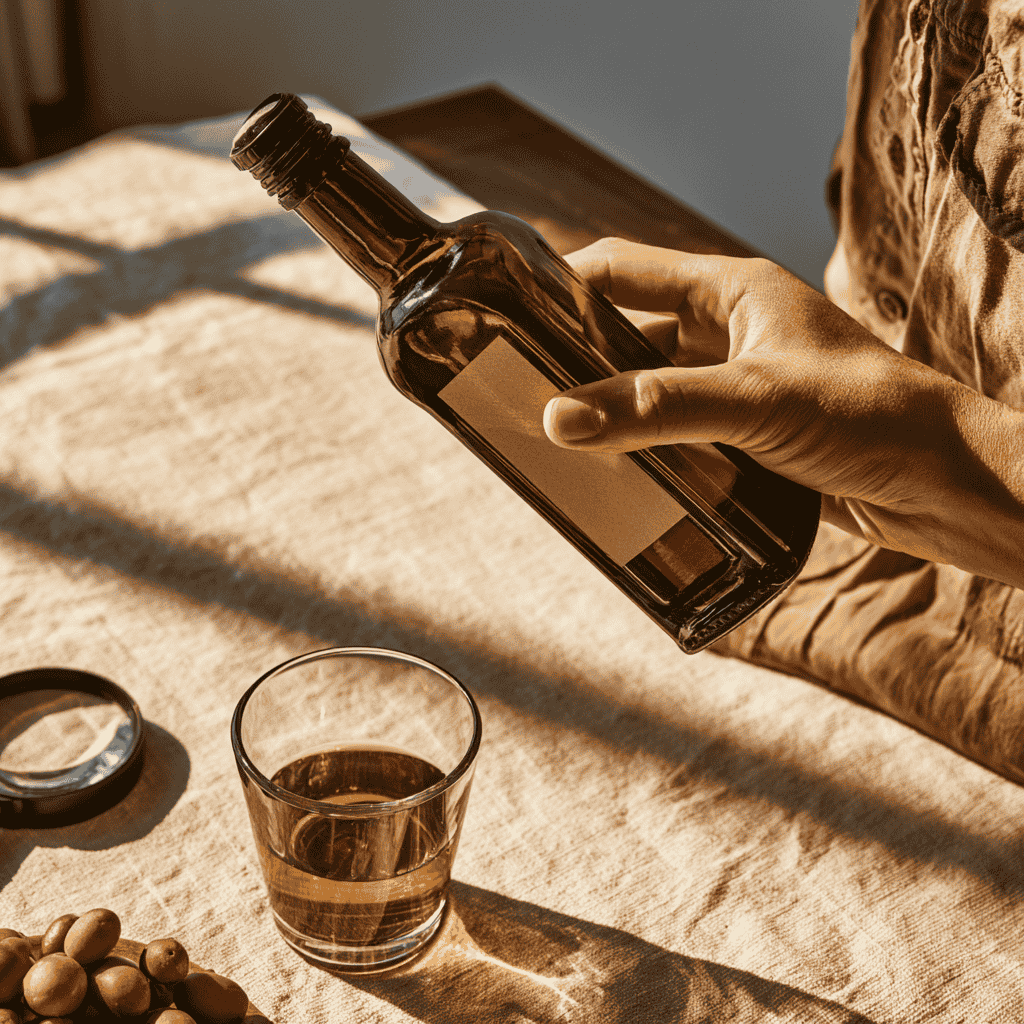
Start at the back of the bottle, not the front. Find the legal designation in small type — extra virgin, virgin, olive oil, or olive-pomace — and treat the front as decoration. "Light", "pure", and "premium" are not legal terms.
Next, look for origin and harvest or best-before information. Dark glass or tin beats clear plastic, because light degrades phenolics within weeks.
Keep the bottle capped, away from oxygen and heat, ideally under 20°C. In Pakistan, the biggest quality loss usually happens in storage, not in Spain.
Does filtered versus unfiltered change the grade? No — filtration only removes suspended particles and moisture. Both qualify as EVOO if they meet the same criteria, though filtered is the safer default in Pakistan's climate.
One caution on authenticity: bitterness and pepperiness can indicate phenolics, but taste alone cannot establish authenticity, and cloudiness is easily faked. Proper labelling, traceability, and reputable sourcing are the more useful signals.
"Pakistani buyers keep asking which one is 'asli' — both are, legally and chemically. Extra virgin is the first press for flavour and phenolics; pomace is the refined, economical grade for heat. Match the grade to the task and both earn their place."
Frequently Asked Questions
Is pomace olive oil healthy?
It is a reasonable cooking fat, high in monounsaturated fat and free of trans fats. It contains far fewer polyphenols than EVOO because refining removes them, so EVOO has the stronger evidence base for health benefits.
Is pomace olive oil safe for cooking?
Yes. It is a regulated food product under IOC, Codex, and EU standards, and its refined, neutral profile and high heat tolerance make it well suited to frying and high-heat cooking.
Which is better: extra virgin or pomace olive oil?
Neither is better in every respect. EVOO is better for flavour, phenolics, and raw use; pomace is better for cost and high-volume frying. Most households benefit from keeping both.
Can I fry in extra virgin olive oil?
Yes. EVOO has good oxidative stability and is used for frying across the Mediterranean. The trade-offs are cost and the fact that heat destroys the aroma and fruitiness you paid a premium for.
Does pomace olive oil contain hexane?
Hexane is used as a processing solvent in traditional pomace extraction, but it is removed during refining and residual limits are regulated. The finished retail oil is not sold containing hexane.
Which olive oil is best for Pakistani cooking?
For karahi, tarka, biryani, and deep-frying, olive-pomace oil is the practical everyday choice. For salads, dips, raita, and finishing, extra virgin olive oil is the better option.